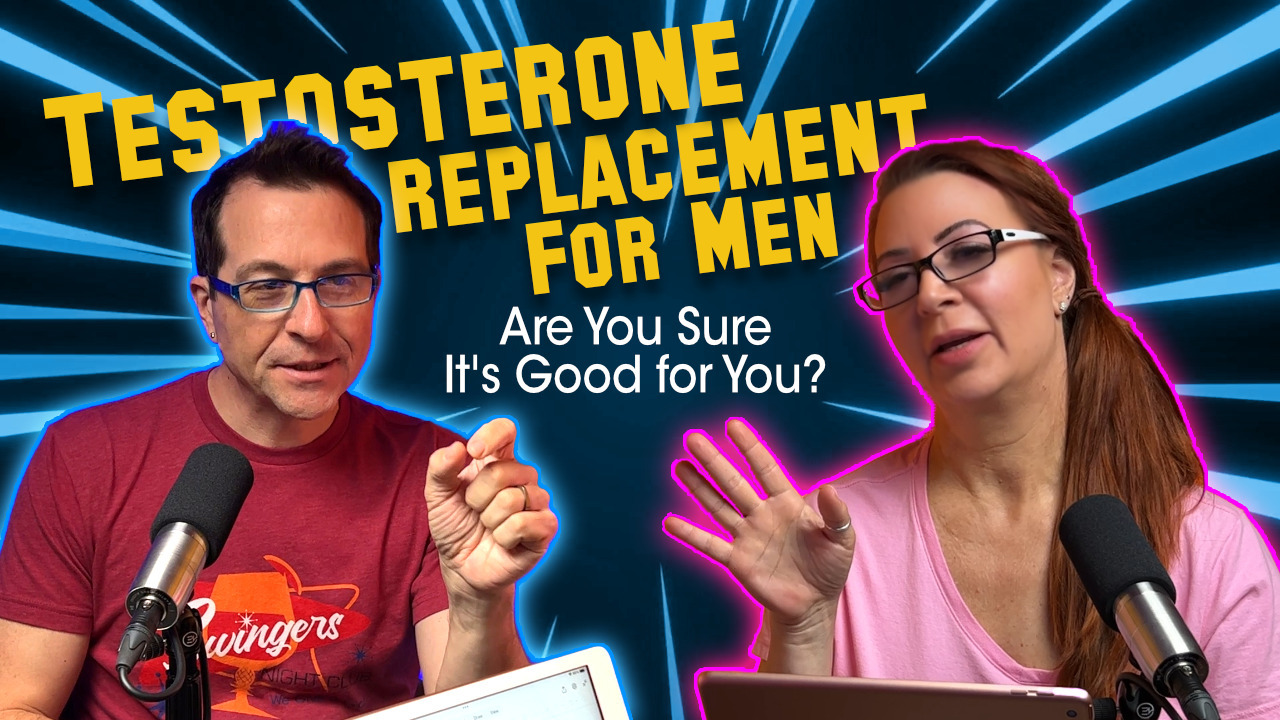
Do men need testosterone replacement therapy? Phoebe discussed some women’s issues in a previous episode about hormone replacement for Women. Gentlemen, today it’s your turn to get the low down on low Testosterone.
Outline
- Reasons:
- Reported benefits:
- Libido, body fat, muscle, mood, energy, bone density, and quality of erections, erectile dysfunction
- Testosterone’s purpose
- May prevent issues as we get older
- Less indication for “healthy” men
- Reported benefits:
- Methods:
- Pellets – painful, less fat, scars
- Injections – less painful
- 2 weeks – big dose, taper off over time, intramuscular
- 1 week – less highs/lows, easier to remember, traditionally intramuscular
- Daily – It’s a routine, less painful, subcutaneous
- Testing
- Before for baseline
- After a month or so to see your levels
- Annual testing once the dose is sorted out
- Side effects
- Acne, hair growth, sleep apnea
- Increased risk of Heart attacks, stroke
- Reduced sperm production
- Estrogen, resulting in breast tissue, and prostate enlargement
- Testing for estrogen
- Estrogen blocker
- Cautions
- No long term testing – benefits / Risks
- “For those who have low testosterone levels but no symptoms, treatment isn’t recommended. It’s also not recommended for those whose levels are low because of aging.”
Want More?
If you want more, check out our BLOG here!
Sources
Testosterone therapy: Potential benefits and risks as you age
Is Testosterone Replacement Therapy Right for You?
260 ‒ Men’s Sexual Health: why it matters, what can go wrong, and how to fix it
Transcript
[00:00] [Ed] Gentlemen, today’s your day to get the lowdown on low-testosterone.
This is very important to understand, as there are some serious risks to taking testosterone
[00:10] [Unknown] if you don’t need it. Welcome to Swinger University, I’m Phoebe, and I’m Ed.
[00:21] [Phoebe] Join us as we explore the exciting world of ethical non-monogamy,
sexual health, and sex education with an intellectual and sexy twist.
Remember to subscribe to our podcast and YouTube channel, be sure to join
our Patreon community for the behind-the-scenes stories and extra sexy content.
[00:42] [Ed] If you like our show, do us a favor and tell a friend about it. We hear all the time how our
podcast helps others, so in the spirit of swinging, please share. One of our listeners commented,
[00:54] [Phoebe] you two are the best, you two are the most intelligent pair on the subject, you do your homework
regarding swinging. Thank you. Thanks Bob, we love you.
[01:05] [Ed] So why should you start taking testosterone as a hormone replacement if you’re a man?
Well, some of the symptoms that you should be looking for would be drop in libido, muscle strength
[01:19] [Unknown] and mass issues, your mood, sleep problems, your workout recoveries, not recovering, bone density,
[01:30] [Ed] the fat distribution in your body and sperm production.
Some people will purport that it helps with erectile dysfunction, not so much from all the
research that we did. It does help with low desire and libido, but that’s different than ED.
[01:49] [Phoebe] How much of it is just a sales pitch by somebody and that’s trying to make a quick buck versus
[01:56] [Ed] legitimate, you know, it’s both. So there are people with these symptoms that really should
consider taking testosterone, but you need to work with a very reputable doctor in order to
determine whether in fact you have low testosterone or not, and that’s the tricky part.
Much like the experience that you had with hormone replacement,
going to just any doctor that’s advertising on the internet or at your local gym or wherever and
saying, hey, I’m having trouble recovering from my workouts. Well, you should take a healthy dose
of testosterone, probably not a good idea. Let’s get into to how you started taking it.
Yeah. Well, we had several friends who were in the lifestyle and they started recommending it.
So a little bit of peer pressure was involved. They purported these huge benefits
of taking testosterone, and I was like, I want a huge benefit. But there’s also this
sales pitch that we had heard about staving off future problems in these symptomatic areas.
[03:12] [Phoebe] And that was really the part that caught our eye. Yeah. The fountain of youth and the
[03:21] [Ed] well, and preventative health, right? I don’t want to go in when I have a health issue and then
[03:28] [Unknown] try and fix it. I’m 100% in terms of how do I prevent getting sick in the first place? I want to
[03:36] [Ed] have these issues. So we went in for a two for one deal when you went in to get your hormone
replacement consult. And they were doing a discount. Right. And I said, well, it’s basically free.
Right. And everybody says it’s a great thing. Maybe I should do it too. Yeah. That was potentially
a huge mistake on my part. So it went from a huge benefit to a huge mistake. Yeah. And one of
the things that should have set me off at the very beginning was we don’t know that it’s bad.
We haven’t seen any bad side effects from it. So what’s the harm in taking it? Because we think
[04:22] [Unknown] it prevents these other things. That’s the problem. There are no long-term studies
[04:30] [Ed] talking about these benefits and these health preventative benefits. What’s the process?
If you have those symptoms, go get tested. And they do the testing before you start treatment so
that you have a baseline. They want to know what your free testosterone levels are. And they test
you after you’ve been on the testosterone for a month because they want to see where your
levels have risen to to see if they got the right dosage. And once they get you where they
think you should be in terms of your levels, you go in annually to make sure that your body
hasn’t adjusted or compensated or every six months to make sure that they still have the
[05:13] [Unknown] dosage right. This is where it gets complicated. So only 2% of the testosterone in your body is
[05:24] [Ed] free testosterone. That means it’s floating around in your bloodstream. All the rest of the
testosterone is locked up in the cellular processes that are going on in your body.
Free tea, as I’m going to call it, is what correlates to those symptoms. So if you have low
free testosterone, that’s probably why you have some of those symptoms.
Here’s the real problem. You’re a 50 year old man and you go in and you get tested and you say,
hey doc, what should my testosterone levels be? And the doc will say, I have no idea.
If they tell you anything different, they’re making it up. Because at this point, there’s only data
[06:06] [Unknown] for anybody who’s a man over the age of 18. That means that 18 year olds, 20, 30, 50, 80 year olds
[06:15] [Ed] are all lumped together into a giant glob of data. They have no direct age to testosterone
levels data. So they have no idea what your specific testosterone levels should be. They can
generalize. But that’s a big generalization. That’s interesting. Even women have an age
[06:39] [Phoebe] range data indicator. Right. You’re 20s and 30s and then your 40s, you’re premenopause and then
your menopause and postmenopause. We have all that data for our testosterone. Actually,
[06:55] [Ed] there’ve been more studies, apparently, for women than there have been for men. Interesting.
So let’s get back to this 2% testosterone, this free tea. What happens in your body when your
testosterone increases? That floating testosterone, if it’s past your 2% level, your body starts
producing something called sex hormone binding globulin, or SHBG. It produces more of it
[07:27] [Unknown] to absorb the testosterone above the 2%. So if you’re taking it beyond the 2%, your body’s
[07:36] [Ed] fighting to get rid of it at the exact same time. Interesting. So it’s the complication of
hence the complication. And the other question that a lot of doctors try to figure out is,
this free testosterone isn’t being used well. So let’s say you do have 2% floating around.
If the Androgen receptors in your body are already saturated, in other words, this testosterone
[08:04] [Unknown] already on them, adding more than the 2%, they can’t be absorbed by the body. They can’t be
[08:13] [Ed] utilized. Why? Because you’re full. It’s like topping off your gas tank. Once the tank is full,
[08:20] [Unknown] the tank is full. Yeah. Interesting. Yeah. I was watching an interesting interview with Dr.
[08:29] [Ed] Cara Mohit Cara, and there were two doctors that were discussing testosterone. They were going
back and forth, and both of them concluded that if their patients don’t have symptoms,
and there’s that big list of things that we talked about at the beginning, they don’t treat
with testosterone. They just, they don’t find it effective. They don’t think it is successful,
and the risks outweigh any of the potential benefits. What if you’re growing muscle mass?
Would you be using it? You would be. You would, but your body’s already producing the 2%,
and if it’s being absorbed by those Androgen receptors, then where’s the excess going to go?
[09:15] [Unknown] It’s not like your body can absorb more, and your muscle building, which I’ll talk about,
[09:22] [Ed] because I think muscle building is probably the big thing that a lot of men who are listening
to this are thinking about, especially with testosterone. Because I’m thinking, doesn’t your muscle
just suck it up? It does, but it’s already in your metabolic, the molecular structure of your
body. It’s already got a bunch of testosterone for doing a lot of that kind of stuff. So the
free tea is it’s just what’s left. Like I said, it’s 2% of all the testosterone in your body.
[09:49] [Phoebe] So it’s not that high a percentage. Interesting. Okay, let’s talk about some of the methods.
[09:56] [Ed] We talked about women and how they take hormones. You can ingest them orally, men, not so much
[10:02] [Unknown] with testosterone. Two reasons. The quantity of testosterone that men have floating around in
[10:08] [Ed] their bodies pretty high. Like we absorb a fair amount of testosterone because we have a lot of
it floating around a lot more than women have because it’s our primary hormone. So the prescribed
methods that work really well for men are patches and gels. Although I would say that anything that
you’re applying to your skin, there’s a lot of side effects with that. If you’ve got lotion or
a lot of hair or you don’t rub it in really well or you don’t use enough, right? The dosage is
pretty like you’re squeezing lotion out onto your hands. Yes, and it’s messy. I lived with someone
[10:47] [Phoebe] that was prescribed the gel lotion and it was massive amounts of quantity on the inner arms and
thighs and it was just, it was sticky and messy. Every day it was a pain in the
[11:01] [Unknown] to apply and you can’t touch anything. And you can’t touch your partner, which is another really
[11:06] [Ed] important thing to consider. You have to wait till it’s fully absorbed. Otherwise, your partner
will absorb that testosterone and you don’t want your lady friend if you’re in that kind of a
[11:17] [Unknown] relationship absorbing testosterone. Now if you’re a guy, not necessarily as big a deal, but if they
[11:23] [Ed] don’t have symptoms, then you’re giving them testosterone and they don’t need it. So regardless
of what your sexual orientation is, you shouldn’t be sharing your dosage with your partner.
[11:32] [Phoebe] It was annoying, I will say, because even when it was starting to get rubbed on the thighs
and I was nervous about the toilet seat. Right. Because transfer. Right. What happens with myself,
[11:45] [Ed] Tanner? It’s fricking everywhere. You get it on you if I don’t lie down. Yeah,
[11:53] [Phoebe] little orange paste. Ed with a little orange ring. It’s funny. I can’t help but think it rubs
[12:03] [Ed] the lotion or else it gets. Let’s talk about the next method for administering testosterone.
And this is the method that I started with in its pellets. They have some nice benefits to them.
I’ll kind of talk about the benefits first and then I’ll talk about the cons.
One, the pellets are a time-release capsule. They’re injected into your fat deposits, usually in
your side. At least that’s where it was on me. If and the nice thing is it’s you do it once and
every four months, three to four months. You get injected and every three to four months,
you can go back and get a new pellet because it slowly absorbs into the body over that
[12:50] [Unknown] time and when you get low, you refill. Downsides, men typically have less fat in their body and
getting an injection into your tissue and it’s it is not a painless process. They’re basically
[13:09] [Ed] shutting a large gauge needle, a very large gauge needle into your side and then they have to
[13:17] [Unknown] butterfly suture it back together. You end up with a whole bunch of neat little half moon scars
[13:24] [Ed] wherever they do the injections and hurt me probably for a good two, three weeks. I was in pain.
Sleeping is awkward. It’s just not a comfortable process. I did not like it at all.
I have tattoos and I have a high threshold for pain, typically.
[13:49] [Phoebe] It’s more challenging for men who have more thinner physique because there is less fat
to tap into and that skin is thinner. It’s closer to the muscle and so it’s not
[14:04] [Ed] there’s enough padding to hide it. If you think back to the symptoms and you think to what
your physique looks like, if you’re not having the fat deposit issues or the muscle building issues
because you’re a fit person, you should really think twice about why you would need a pellet
[14:24] [Unknown] because you already have lean body mass. We need your help so that your community, the very one you
[14:36] [Ed] love and have so much fun with can also find our show. Here’s a really easy way to do that.
If you’re listening on Apple Podcasts or Spotify, hit that follow button and leave us a rating.
If you’re watching on YouTube, subscribe and turn on notifications.
We can’t emphasize enough how much this helps the Swinger community and it truly is up to you
to make that happen. It makes a massive difference in whether new listeners can even find us.
And here’s the thing. When someone searches Swinger Podcast, the algorithm doesn’t care
[15:14] [Unknown] how good our content is or how long we’ve been around. It only cares about ratings and reviews.
[15:22] [Ed] We’d appreciate it and your community will really appreciate it. Thanks for listening.
[15:32] [Phoebe] Okay, I’m still not like I’m still have questions about the muscle building but we’re going to go
[15:38] [Ed] we’ll get into that. Okay. Injections. And this was the method that I finally settled on after
doing the pellet the first round. Didn’t want to go back had needle fear. So what did I do?
I chose a hypodermic needle injected every single day for a very small dosage of testosterone.
Traditionally, testosterone is administered every two weeks. It’s a large dose or a larger dose.
And it tapers off over those two week period and then you go back in and you get another shot.
One of the downsides with the two week version is that it’s intramuscular. So it’s a fairly large
[16:19] [Unknown] gauge needle and it goes straight into your muscle tissue. That hurts. But because you’re only
doing it every two weeks, maybe it’s not so bad. Traditional method nowadays is one week injections.
And a lot of people do that because it’s easier to remember because you only have to do it once.
[16:40] [Ed] And so it’s like every Monday you you do the the injection. And the ups and downs. In other words,
that taper off period and then the injection. It’s a little bit more regular. So it’s not as a high
a high and a low a low. You you kind of maintain a steady or level. But it’s still intramuscular. So
it’s still painful. I took a route of daily injections, which were establishing a routine.
So every morning I would get up. It’s a much smaller dosage. It’s less painful because it doesn’t
go intramuscular. You can inject it kind of into the fat deposits that you have on your side.
So it’s just subcutaneous. And those small bumps every day keep a pretty steady stream of
[17:29] [Unknown] testosterone in your system. Okay. So what are some of the side effects? Acne,
[17:36] [Ed] hair growth, sleep apnea. Those are all pretty common symptoms or side effects.
The hair on your legs is massive now. Yeah. I got my hair. My legs got very hairy. Gorilla.
And the back of my neck kind of where my hairline is. I have to shave that now more frequently.
Like every couple days, which I didn’t have to do before. That’s going to dissipate.
I hope so. And that’s we’re going to talk about why it might dissipate.
Here’s some more serious side effects because you know a pimple here and there,
although if you are prone to acne, your acne could be pretty severe. So it’s almost like going
through puberty again. If you had mild acne when you were a teenager, you’d probably have
[18:24] [Phoebe] the same level of acne. So what’s the acne on some guys’ backs? That’s from steroids.
[18:33] [Unknown] And it’s a very similar side effect. Shrinking of the testicles, acne on the back,
[18:40] [Ed] but steroids are a different thing than testosterone. There’s more to it than that.
The more serious side effects increase risk of heart attacks and stroke. So clotting and brine.
[18:56] [Phoebe] That’s a pretty serious risk. Now this is with pretty high levels of testosterone. I mean,
[19:02] [Ed] you’re you’re pushing. I didn’t look at the exact risk percentages. But just knowing that you don’t
need it. And this is a potential side effect, you should really question whether the benefit is
worth the risk. Got it. Even if it’s a small percentage. If you’re not, if you’re not going to
[19:25] [Unknown] get a benefit from it, why would you take that risk? Got it. Here’s another more serious risk
[19:33] [Ed] or side effect. Reduced sperm production and your testicle shrinking, which I talked about
happening with steroids, testosterone does the same thing because your testes are where you
produce some of the testosterone. So if you introduce an artificial source, your natural
source of testosterone does, it’s like, hey, I can take the day off. I don’t need to produce
anymore. Exactly. If you are trying to have a baby and you need to be fertile, this may prevent
[20:03] [Unknown] you from having a baby. This may prevent you from being fertile. So younger men be very, very
[20:13] [Ed] cautious about taking testosterone if you don’t need it because you’re risking that relationship
with your wife and your happiness and all the things that you set out for goals with family.
Here’s another side effect. Estrogen. So the some of the testosterone does get converted into
estrogen and high levels of estrogen will cause the growth of breast tissue and really important
prostate enlargement, which puts you at risk for prostate cancer, which is not good.
[20:51] [Unknown] It’s very fast growing cancer and it will probably kill you. So if you don’t need it, if you don’t
[20:59] [Ed] have symptoms, your body can become dependent on it because you don’t need it. It starts
shutting down your natural production and now your body may actually become dependent on this
[21:13] [Unknown] artificial source. Interesting. Yeah. Taking too much of it will also rob you of sleep. So
[21:24] [Ed] your amped up, your juice up, your metabolism is up, which is probably why the fat production
goes down when you’re on testosterone and helps with the muscle building because your metabolism is
up. Right. But lack of sleep causes all kinds of other side effects like not being able to recover.
[21:44] [Unknown] So if you’re taking too much testosterone, you’re not helping your muscle recovery because you can’t
sleep. What are their cautions? This really speaks to the long-term benefits issue.
There’s no long-term testing. They haven’t looked at it. If you look at the data that we talked
[22:08] [Ed] about at the beginning where it’s 18 to death in terms of the data being all glombed together,
they haven’t done enough studies on this. They haven’t really looked at whether or not there are
long-term benefits to this. So you’re taking a pretty big risk that someone is telling you that
[22:30] [Unknown] there are benefits even though there are no studies for it. For those who have low testosterone
[22:37] [Ed] levels but no symptoms, treatment isn’t recommended. It’s also not recommended for those whose levels are
low because of aging. Now that’s a key quote from Dr. Mohit because a lot of people are taking
testosterone as they age because they’re trying to get back their youthful vigor. If a man has
symptoms of low testosterone and has a testosterone value of less than 300 nanograms per deciliter,
he should consider starting testosterone replacement therapy and that’s Dr. Kara. So once again,
two criteria. You actually have low testosterone and you have symptoms. Most important thing
[23:23] [Unknown] don’t fall for the hype. What are some of the preventative steps? A lot of the symptoms that are
[23:30] [Ed] in here that I think men are mostly concerned about which is building muscle and staying youthful
and kind of those preventative things that I mean that’s what sold me on the whole thing.
[23:41] [Unknown] You can actually get those benefits with diet, exercise, and sleep. Now those things require work,
[23:49] [Ed] although sleeping requires more discipline than work. Those three things will give you the benefits
that you’re looking for from testosterone and they don’t require prescription. So I’m going to talk
about my personal story because I’ve mentioned a few times that I’m not on testosterone anymore,
testosterone replacement. I started reevaluating my usage when Phoebe started doing her research
and figuring out why the benefits weren’t necessarily everything that they were touted to be.
So I of course said, gee, I wonder if I got sold the same bill of goods. I wonder if I’m taking
something that I don’t need to. I wasn’t having libido issues. And so for me, it was all these long-term
preventative things. I did see some muscle growth, but honestly, the muscle growth that I saw was
[24:46] [Unknown] was also directly correlated to me exercising more. So yeah, the testosterone could have helped,
[24:54] [Ed] but just working out more regularly would have also helped. Then I did some digging. So when I was
researching this episode and I started listening to some of these other interviews with doctors and
some of their test results, I went back and looked at all of my test results from 2015 to 2022 when
I first started the testosterone process. In 2015, I had a free testosterone level of 1.98%
so right at that 2% mark. In February of 2022, where I thought I might have low testosterone,
[25:36] [Unknown] my level is at 1.51%. So I started the low T, the treatment for testosterone, thinking that that
[25:47] [Ed] would help. And it did go back up. It went up to 2.09% in March of 2022. And then in July,
[25:59] [Unknown] I was way up there at 2.67%. But in thinking about it and looking at these numbers,
[26:06] [Ed] even at 1.5%, that’s not really that low. And I looked at the other numbers that I had and my
[26:17] [Unknown] non-free testosterone levels were fine. So I wasn’t really suffering from low testosterone. Now,
[26:24] [Ed] hearing all of these numbers and statistics from my health doesn’t necessarily mean that you
shouldn’t take testosterone. Once again, if you have the symptoms and you work with your doctor
to determine whether you needed or not, you should consider it, especially if you have a health
need. One of our listeners, watchers on YouTube had a comment, Ken of Ken, and his results with
taking testosterone aligned with what I had researched. And really, he’d seen some benefits,
some of these symptoms were alleviated for him. So Ken had a key quote that I want to pull out
here, which is, don’t believe all the hype. It won’t restore you to your 25-year-old self.
And that’s important to remember. You can’t think of this as some cure-all or miracle youth serum.
It’s not going to turn you into a 20-year-old. And those long-term benefits that a lot of people
are trying to sell you on, we don’t know that those are true. So be very careful. We hope you
gained a little more knowledge about hormone replacement for men. You can benefit from our research
and experiences to help make a more informed decision for yourself. For more facts and a deeper dive,
check out our blog on this subject. And if you want to review the lady side of hormone replacement
therapy, check out our episodes for women. Thank you for tuning in and we appreciate you
[27:58] [Unknown] joining our community. Don’t forget your homework. Tell a friend about our show and leave a review
and comment. You can also leave us a voicemail at 916-538-0482 or contact us at SwingerUniversity.com.
Keep learning, keep growing, and keep it sexy. Oh, one last thing before you go. If this episode
[29:23] [Ed] helped you in any way, the single best thing you can do to support the show is leaving a rating
and review. It takes 60 seconds and helps new people find us when they’re searching for
[29:33] [Unknown] relationship education. And we’ve made it easy. Visit SwingerUniversity.com forward slash review.
[29:43] [Ed] All the instructions are there. Thank you for being part of this community. We’ll see you again