
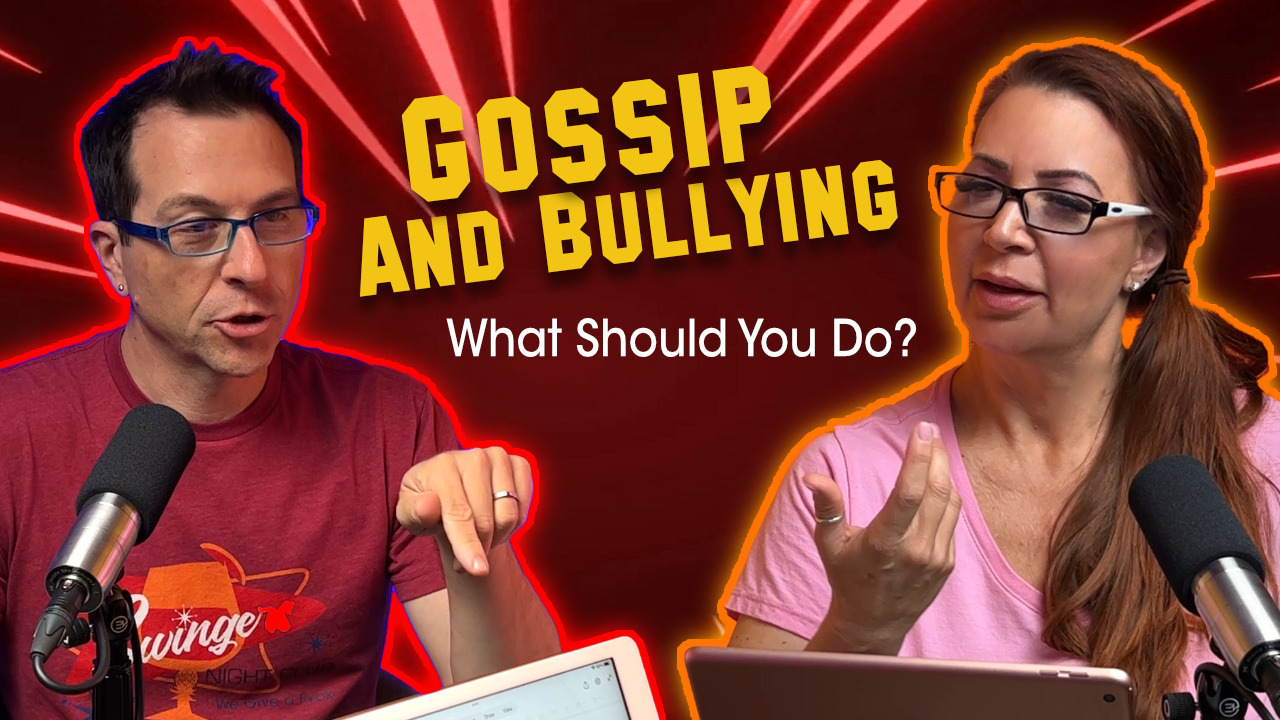
Do you ‘Kiss and Tell’? What does that exactly mean? Is it different than gossip and how can that help in the lifestyle? We talk about the good, the bad, and when it turns to bullying! Plus you will learn how to stop negative gossip and bullying.
Join Ed and Phoebe in this enlightening episode as they delve into the intriguing world of ethical non-monogamy, exploring the depths of gossip in the swinger lifestyle. Learn about the nuances of good and bad gossip, how to handle negativity and bullying, and discover the power of effective communication within the community.
🔍 Key Topics & Timestamps:
- 0:00 – Introduction: Ethical Non-Monogamy & Gossip
- 1:34 – What is Gossip, and Why Do We Do It?
- 7:12 – The Historical Significance of Gossip
- 10:58 – Gossip as a Tool for Building Trust
- 15:20 – The Importance of Social Skills
- 19:03 – Strategies to Combat Negative Gossip
- 22:41 – Real-Life Examples & Impact of Gossip
- 27:09 – Speaking Up & Addressing Conflicts
- 29:58 – Event Organizers’ Role in Maintaining a Safe Community
Transcript
[00:00] [Ed] They could take the story that you told, pass it to somebody else, and say I can’t believe that so-and-so is actually spreading this kind of
[00:08] [Unknown] stuff around.
[00:14] [Ed] Welcome to Swinger University. I’m Ed.
And I’m Phoebe.
Join us as we explore the exciting world of ethical, non-monogamy,
sexual health, and sex education with an intellectual and sexy twist.
[00:27] [Phoebe] Do you kiss and tell what does it exactly mean?
Is it different than gossip and how can that help in the lifestyle?
We talk about the good, the bad, and when it turns to bullying.
Plus, you will learn how to stop it.
[00:38] [Ed] Remember to subscribe to our podcast and YouTube channel.
Be sure to join our Patreon community for the behind-the-scenes stories and extra sexy content.
[00:48] [Phoebe] If you like our show, do us a favor and tell a friend about it.
We hear all the time how our podcast helps others.
And when the spirit of swinging, please share.
[00:55] [Ed] Karen wrote in and asked about our first experiences, our insecurities and pressure to play.
As well as her issues with aggressive women in lifestyle.
[01:07] [Phoebe] So when she wrote in, I sent her a very nice, long email and kind of helped her through some of
those challenges that she was having.
And it also helped spawn this episode as well.
Yeah.
So we really do thank you for writing in and asking those questions.
We appreciate it.
[01:27] [Ed] So if you have questions about the lifestyle, please contact us.
[01:32] [Phoebe] All right, who gossips?
Apparently all of us.
Right.
Even when you don’t think that you are, you do.
And the average person actually gossips 52 minutes a day.
According to a 2019 study in the Journal of Social Psychological and Personality Science.
Learned that most gossip was neutral.
The urge to discuss your family details can be very helpful and natural.
So that is a form of gossip that we all perform every day life.
And a lot of the family members will, we’ll share like job promotions.
[02:12] [Unknown] Someone got married, a lot of houses that are right.
[02:15] [Phoebe] This is all considered gossip.
So it’s right.
You’re talking about somebody else and what’s going on with them.
And as we are family, it can be someone who’s talking about
another person or a couple that breaks the rules all the time or as maybe they’re too rough or
oh gosh, maybe they lose a condo.
[02:41] [Unknown] And I’m laughing because you have to check out that other episode.
[02:46] [Phoebe] So what is gossip exactly, right?
[02:51] [Unknown] It’s normal.
[02:53] [Phoebe] We all do it.
And there is a bad version of gossip.
Mostly that’s what gossip is known for.
You hear the word gossip and it’s like, I got it.
[03:02] [Ed] This is what people think of when they hear the word gossip.
Yeah, it’s negative.
[03:05] [Phoebe] It’s got a negative connotation to it.
And the bad gossip is a person who habitually reveals personal or sensational facts about others.
The good gossip is casual or unconstrained conversation or reports about other people,
typically involving details that are not confirmed as being true.
So observations, things like that, it’s
common informational type of sharing.
Why do we do it?
Right, if it has such a negative connotation to it, why do we do it?
And I didn’t even know there was a good kind.
So now I know there’s a good kind.
And here’s why it’s beneficial.
Apparently we can’t help it.
According to Dr. Frank McGandrew, a psychology professor at Knox College,
who researches the evolution and psychology of gossip.
In earlier societies, we needed to know what people or groups were dependable,
who had the power and who had powerful friends.
This sharing of gossip was a way of also getting that information, right?
And maintaining your family core as a strong unit, which was really necessary
for informing other family members.
We were talking resources, safety, all that.
And then knowing who are those people outside of us that could potentially harm us,
who are our friends, our allies, all that.
So sharing of this information gossip, critical.
When I was researching this, I started to think about when we were in Vegas.
And we went to the museum, right?
[04:43] [Ed] The mob family, they talk about that and how information spreads.
So quickly, because they’re all connected,
and they’re all informing each other of what’s going on in the community,
with all the businesses, etc.
[04:58] [Phoebe] Yes.
So now you can kind of get a picture of that family unit tribe,
right?
Trying to protect their own.
Gossip will also show some vulnerability.
It’s a way of building trust and bond with others.
And it really is a social skill.
So if you don’t have it, you’re kind of left behind.
[05:22] [Ed] Right.
You’re left out of that chain of communication.
You’re not building that bond with co-workers or friends,
because you’re not really engaging with those personal details.
You’re not engaging with letting people in on what’s going on in your life.
[05:42] [Phoebe] Yes.
And early on, I had a difficult time doing this,
because I didn’t do the gossip thing.
Right.
I kept my life very private.
I kept other lives very private.
I didn’t share other people’s information.
It made me feel alienated.
People couldn’t gauge me.
They’re like, can I trust her?
She doesn’t share anything.
So I don’t know where I stand.
And she doesn’t give me anything to grab on to the tricky part.
When we should do it, how we do it.
So that negative gossip is that intentional spread of information
to make people look bad and make themselves look good.
[06:29] [Ed] Right.
So this is that whole tearing people down
in order to build yourself up
and taking credit for other people’s work and all of that kind of stuff.
Yeah, it’s just, it’s just bad.
[06:41] [Phoebe] It’s bad, it’s ugly.
And we see this a lot of time
in Swinger Facebook chat groups.
And it’s just, it’s not very pretty.
[06:51] [Ed] You can also do unintentional damage by spreading gossip
or at least talking about other people
because you don’t necessarily know who’s listening.
And you could inadvertently hurt somebody else’s feelings
by spreading this information.
And in a sense, letting a secret out without somebody else
knowing that you’re telling their secrets.
[07:13] [Unknown] Positive gossip would be more discreet.
[07:18] [Phoebe] You’re not adding false details.
It’s not mean-spirited.
[07:24] [Unknown] And you hopefully are doing a gut check.
[07:28] [Phoebe] Yeah.
Does it make you feel bad to say that information?
Does it give you that cringy feeling?
If it does, then, you know, we probably shouldn’t be saying it.
[07:37] [Ed] Right.
Assuming that your moral compass isn’t out of whack to be fair with.
But yeah, so have a little bit of caution
when you’re talking about other people.
For example, be careful who you open up to.
If they’re really close friends and you know
that they will keep the confidence,
then that’s probably pretty safe.
And thinking about that, the converse would be
someone who’s constantly gossiping
and maybe spreading things around.
Not such a good person to confide in.
[08:11] [Phoebe] It could be risky because they might turn it around on you.
Right.
And it’s easy to get into that trap
[08:18] [Unknown] because they’re like sharing information.
[08:21] [Phoebe] But then you realize, oh shit, you know, later.
Oh, all my stuff got disclosed as well.
[08:28] [Ed] Right.
And if it’s a person who’s using gossip as a weapon
in order to tear people down,
[08:35] [Phoebe] or gain attention.
[08:36] [Ed] Or gain attention.
They could take the story that you told,
pass it to somebody else and say,
I can’t believe that so-and-so is actually
spreading this kind of stuff around.
They look better because they’re talking about you
as being the bad gossip.
And now you’ve just become the bad guy.
[08:56] [Phoebe] Sometimes I wonder, are we back in seventh grade?
[09:00] [Ed] The internet makes me feel like that almost every day.
[09:03] [Phoebe] How do you stop this?
You want to be direct.
You can say things like,
I don’t want to talk about this.
[09:12] [Unknown] Or you could say, I don’t have anything to say.
[09:16] [Phoebe] And you just say it with a smile, just like that.
It usually stops the conversation.
[09:20] [Unknown] If they don’t get it and they keep talking,
[09:23] [Phoebe] you just repeat it.
If you repeat something three times the same thing,
they will get the hint.
You can also change the subject.
That also works.
Some people, it doesn’t work so well for them.
Don’t worry about seeming rude.
It doesn’t really matter.
Just don’t worry about it.
[09:45] [Ed] All right, we need your help so that your community,
the very one you love and have so much fun with,
can also find our show.
Here’s a really easy way to do that.
If you’re listening on Apple Podcasts or Spotify,
hit that follow button and leave us a rating.
If you’re watching on YouTube,
subscribe and turn on notifications.
We can’t emphasize enough how much this helps the Swinger community.
And it truly is up to you to make that happen.
It makes a massive difference in whether new listeners
can even find us.
And here’s the thing.
When someone searches Swinger Podcast,
the algorithm doesn’t care how good our content is.
Or how long we’ve been around.
It only cares about ratings and reviews.
We’d appreciate it.
And your community will really appreciate it.
Thanks for listening.
And another way of saying it too,
which might come across a little bit easier,
or at least give you some deniability is,
I don’t know anything about that.
I haven’t heard.
[10:55] [Phoebe] Yes.
[10:55] [Ed] Because then you’re not part of the situation.
You don’t have any information to contribute.
And they’re certainly not going to ask you for more,
because you’re like, I’ve never even met that person.
Or I didn’t know anything about it.
[11:06] [Phoebe] Another phrase that someone told me that I use often is,
I really can’t say.
[11:12] [Ed] Which is vague enough where it could be interpreted
a couple different ways.
[11:15] [Phoebe] Which is nice.
You really can’t say because you don’t want to say
or you have nothing to say about it.
Right.
It’s not offensive.
And it just moves the conversation right along.
It stops it.
It really does.
[11:27] [Ed] Someone would have to be a real jerk to try and tear into that
and get more information.
So they’ll probably avoid that.
[11:37] [Phoebe] When you’re swinging,
here are some things that you may encounter.
And things that we have encountered in Las Vegas
when we were at the ASN Awards.
We encountered how gossip works really well.
[11:51] [Ed] One of the promoters had canceled an event.
And there was an incident that had happened
at the same location where they usually hold their event.
Wasn’t their event.
It was somebody else’s.
Within 24 hours.
Yes.
The city and the hotel and another hotel
had already heard about that incident.
[12:15] [Phoebe] Boom.
[12:16] [Ed] That phone call the next day, they already knew.
[12:19] [Phoebe] It was phenomenal.
[12:20] [Ed] Right.
[12:21] [Phoebe] The good gossip in a Swinger environment
is sharing information with an organizer or promoter
where an issue is occurring or has occurred.
Right.
Organizers don’t want.
Troublemakers,
if you have a valid issue,
they really do want to hear about it
so that they can get first-hand knowledge,
which is why it’s really, really important not to just go,
whatever and brush it off.
And then gossip about it to others about,
hey, I had this bad experience at a party.
Yes, that does happen.
Does it happen all the time?
No.
But if you don’t tell the promoter,
they can’t do anything about it.
They can do a lot of things.
They can ban them from coming to the event.
Sure.
They can file a police report if need be.
They can bring in some counseling
if that’s warranted.
[13:17] [Ed] Right.
And one of the key things to know about promoters
and event promoters is they all talk to each other.
[13:23] [Phoebe] Yes.
[13:24] [Ed] And so if something happened that was illegal
or unethical or non-consensual,
it’s important to talk to the promoter about it.
So that they’re aware and they can tell other promoters
so that that person can’t continue to behave poorly
[13:41] [Unknown] at other events and create more trouble for other people.
[13:45] [Ed] Like you’re helping your community
by not letting it happen again.
[13:49] [Phoebe] Correct.
Yes.
So you’re helping preserve the community
that good, kindhearted nature of the community
that likes to follow the rules and ask for consent.
So if you’re not speaking up,
you’re allowing those other individuals,
the bad apples kind of ruin it for everybody else.
Yeah.
[14:07] [Ed] The other aspect of this to think about
the promoter going directly
and talking to both parties is important
and you should do the same thing
if you ever hear gossip about people
because assuming that someone isn’t making something up,
assuming that the bad gossip is actually true
is just as bad as spreading the gossip.
So if you hear something about someone that you know personally
talk to them directly about it.
You don’t have to say who told you
but getting that confirmation on your own
allows you to cut the gossip chain off
right there because you won’t continue
to spread that information
if for a fact you know that it’s not true.
[14:51] [Phoebe] Yeah.
I’ve done this with good friends of mine
and I’ve done it with other play partners as well.
Right.
And usually what happens when we hear a piece of gossip
is I catalog it in my brain and go,
[15:07] [Unknown] hmm, okay.
[15:09] [Phoebe] Right.
I don’t have that direct experience with that person
but I will catalog that in my brain
and keep that on file and make sure I
note that if something were to come up.
So it’s like kind of like a little yellow flag, right?
[15:25] [Ed] Right.
[15:26] [Phoebe] And then through my own observations and interactions
based on my own filters,
if I encounter the same thing
then I make my own assessment and go,
you know what?
I can see there’s some truth to this.
And then I can choose whatever I want to do
with that gossip.
The other good gossip at a swinger event
is what we call that kiss and tell.
Well, what is kiss and telling?
It could be a good recommendation for a fun
[15:54] [Unknown] or respectful play couple.
[15:57] [Phoebe] It could be a recommendation for a size queen.
She really likes big,
girthy things.
And so someone can tell her,
oh, you really need to go check out Joe.
He’s a really nice guy.
He’s respectful.
He’s great with both parties.
He shows up to events.
They have a whole list of why he’s great.
I asked someone just last night at a party,
why did they like this guy?
I got information that was really helpful to me.
He was respectful,
courteous, gentle,
showed up on time.
[16:38] [Ed] It’s kind of like a job recommendation.
It was.
[16:40] [Phoebe] Yeah.
It was like,
it’s kind of like an elevator pitch for somebody else.
[16:44] [Ed] In a slight twist to the good gossip,
because you think of these things as all being positive
things, almost like a lot of the swingersites,
[16:53] [Unknown] you can put in a reference on them.
[16:57] [Ed] I can’t remember what SLS called it,
but you can give them some kudos on their profile and say,
hey, they were the best couple.
They were fun and attentive,
and they serve great hors d’oeuvres.
[17:08] [Phoebe] Yeah, quote, certifications of this.
Yeah.
[17:11] [Ed] But the other one that doesn’t sound positive,
but it is.
And that is for that gentleman in the lifestyle
that we’ve run across,
and we’ve heard from several people
that was losing their condom.
And on purpose.
On purpose.
Yeah, they were basically slipping it off
[17:30] [Phoebe] and pretending that it had disappeared
[17:34] [Ed] or trying to just get away with it.
[17:36] [Phoebe] We’ve heard it’s more common lately.
[17:40] [Ed] Yeah.
[17:41] [Phoebe] Yeah, which is a little shocking.
[17:43] [Ed] So that’s a different kind of good gossip.
It’s not positive,
but it’s beneficial to know
[17:50] [Unknown] because women don’t want
[17:54] [Ed] to have that risk floating around in a lifestyle.
[17:58] [Unknown] And we hadn’t passed that along
[18:01] [Ed] until we had heard it from, I think,
two other women.
And then we had it happen.
Mm-hmm.
Yes.
And at that point,
I said,
third time as a charm,
we were definitely sharing that tidbit
when we talked about other people.
Yeah.
Not all the time,
but any time we heard
that particular person’s name mentioned,
we say you should be careful
and really watch
because
this has happened to us, et cetera, et cetera.
[18:30] [Phoebe] Yeah.
And usually what I say is,
[18:32] [Unknown] you know,
[18:33] [Phoebe] very nice couple.
He was fun to play with.
Right.
If you choose to play with him,
be aware of that condom at all times.
Yeah.
I would not recommend being in a doggy position
unless your husband or significant other is watching.
Right.
I, you know, would check frequently
to see if
reach down
and see if it’s still there.
Right.
You could still play,
but check.
It’s a safety awareness.
Safety awareness.
[19:01] [Ed] Yes.
[19:01] [Phoebe] We’re here for safety awareness.
[19:04] [Ed] Your public service and elephant.
[19:07] [Phoebe] Bullying
and negativity in the lifestyle
is rare.
We have seen it.
We have heard it.
And it’s, you know,
the lifestyle is not perfect.
That it is real people.
And there are some bad apples.
Louis just slightly dipped our toe into that arena
of organizing and event and vacation.
We’ve started to see more of that
ugly side, so to speak.
[19:34] [Ed] Right.
Some of the bad behavior.
Well, some of it goes directly
into what we’ve been talking about,
which is spreading rumors.
So false information about you
as opposed to helpful information
to keep you safe.
So the condom guy, for example.
So there are people
who are spreading those
nasty rumors about people.
That’s bad.
sarcasm.
So passive aggressive behaviors
like dropping hurtful or offensive comments.
Most of the time we see that
in forums and chat groups.
Right.
I won’t mention some of them.
We have a love hate relationship
with one of the groups on Reddit.
And we see a lot of that,
which kind of plays into this next one,
which is cyberbullying.
[20:21] [Unknown] So creating multiple accounts
[20:24] [Ed] for downloading people,
leaving nasty comments,
and really kind of
ganging up on people who aren’t promoting
the thing that you promote
or the thing that you say.
Right.
This is one that we were afraid of
when we first came out last October
because we’ve seen this happen
to other podcasters.
And we’ve seen it happen
to people in the lifestyle.
And that’s
outing them in the community.
It’s pre-extreme.
But not as common as you might think it is.
[20:59] [Phoebe] But when it happens,
it’s usually big.
[21:03] [Ed] Really bad.
One of the most extreme examples we ran
across of this was
in Colorado when we were attending
a house party,
there was a local club
that had a overly enthusiastic member
who decided to take it upon themselves
to out everybody who was going
to house parties as a way of protecting
this club.
They printed up flyers.
They went door to door
in the neighborhood.
They doxed people.
They made all kinds of crazy accusations
about what these people were doing,
including prostitution and human trafficking
and drug trade,
like crazy shit that they were making up
because they were basically
trying to do a favor to the club
by destroying this, quote,
competing business environment.
Really bad.
Even when H.O.A.’s got involved
in terms of getting people
kicked out of communities kind of things.
It’s terrible.
[22:12] [Phoebe] I mean, even when bad shit
lost their homes or jobs,
everything.
It was horrible.
Yeah, it were bad.
Yeah, bad, bad.
[22:19] [Ed] And one of the other things
that comes out of this is
sometimes this is a personality disorder.
People are compelled to spread lies
in order to feel important and gain attention.
So they’re anti-social
or they have an narcissistic complex
or a histrionic complex
[22:38] [Unknown] where that’s just kind of built
[22:41] [Ed] into who they are.
[22:42] [Unknown] Like that’s how they feel good about themselves.
[22:47] [Ed] Right.
[22:50] [Phoebe] If you have conflict
and an event or in the community,
try to take a breath,
think about it twice,
act once and avoid using social media
or text messages to solve it
because it’s never going to work out.
Well, it’s just not the best.
I know it’s hard.
It’s just not the best way to do it.
You really want to de-escalate it.
You want to be wiser
and smarter about it.
And it’s safer to take this approach.
You can ask for a private setting
or meeting if you really want to
address it with this individual.
You can invite a third party
as the mediator.
If it’s at an event,
you can ask the party organizer,
vent organizer to be that mediator
[23:43] [Unknown] in that three way.
Right.
[23:47] [Phoebe] Share the feelings,
focus on clear communication.
Don’t use the word you.
Provide specific examples.
And ultimately,
hopefully get to a shared resolution.
You can even come up
with shared resolution
that you think might be good for both parties.
It’s really trying to step out of those emotions
and make that repair,
even though it wasn’t your fault,
which is really frustrating.
Right.
Because you’re negotiating with someone
who’s wronged you and destroyed you.
And now you have to rise above all of that.
[24:28] [Ed] Right.
Trying to do the right thing.
[24:30] [Phoebe] It’s very difficult and challenging,
but it is honestly the best way to do it.
[24:36] [Ed] One of the biggest challenges
with having this happen at an event
[24:40] [Unknown] is people are typically
[24:43] [Ed] having fun,
probably drunk.
[24:46] [Unknown] Yeah.
[24:47] [Ed] Probably high on something.
Because they’re not necessarily
in the correct state of mind
to prevent themselves from doing it.
In other words, their inhibitions are lowered
and so things are coming out of their mouth.
[25:00] [Unknown] Right.
[25:01] [Ed] So trying to have a conversation with them
and resolve something in that state,
I’ve been there.
It’s not really possible.
Right.
They’re not fully there
to comprehend what’s going on.
And they’re certainly not going to be considered
of your feelings about the whole thing.
Because they’re kind of in their own little world
at that time.
[25:20] [Phoebe] Right.
But that is also why getting to that event organizer
is important because they can,
you know,
take that situation and diffuse it
and then bring all the parties back together
so that you’re not banned from their event anymore,
really, honestly.
And hopefully everything gets resolved.
[25:45] [Ed] In a sense what it is
[25:47] [Unknown] is making the event organizer aware of the situation
[25:52] [Ed] so that they can make a more informed decision
about what they’re going to do about it.
It may not get resolved that night.
But at least everybody’s on the same page
in terms of what happened
and why it probably happened.
[26:07] [Phoebe] Because really, three people are involved.
The event organizer,
because they don’t want bad promotion.
They don’t want their community
that they help and serve
and provide, you know,
a place to come and enjoy.
They don’t want that compromised
[26:23] [Unknown] because they want people to come back.
[26:25] [Phoebe] They want people to come back
because they really are providing
a community.
It’s not all possible.
But if we can get there
after one of these things occur,
that would be ideal.
[26:37] [Ed] So here’s a question for you listeners.
Have you ever experienced
good gossip in the lifestyle?
How about bullying?
We’d love to hear your experiences.
So leave us a comment
or write to us
or leave us a voicemail.
[26:53] [Phoebe] Some of the key takeaways are
gossip is helpful to others,
especially when it’s
safety oriented.
Don’t be a bully
and don’t do it in a lifestyle.
Be confident,
nip it in the bud
and don’t worry about
seeming to be rude.
[27:13] [Ed] Thanks for tuning in.
We appreciate you joining our community.
Don’t forget your homework.
Tell a friend about our show
and leave a review and comment.
You can also leave us a voicemail
at 916-538-0482.
And you can contact us
through our website at SwingerUniversity.com.
Keep learning,
keep growing,
and keep it sexy.
[27:41] [Unknown] Oh, one last thing before you go.
[27:59] [Ed] If this episode helped you in any way,
the single best thing you can do
to support the show is leaving a rating
and review.
It takes 60 seconds
and helps new people find us
when they’re searching for relationship education.
And we’ve made it easy.
Visit SwingerUniversity.com
forward slash review.
All the instructions are there.
Thank you for being part of this community.
We’ll see you again soon.