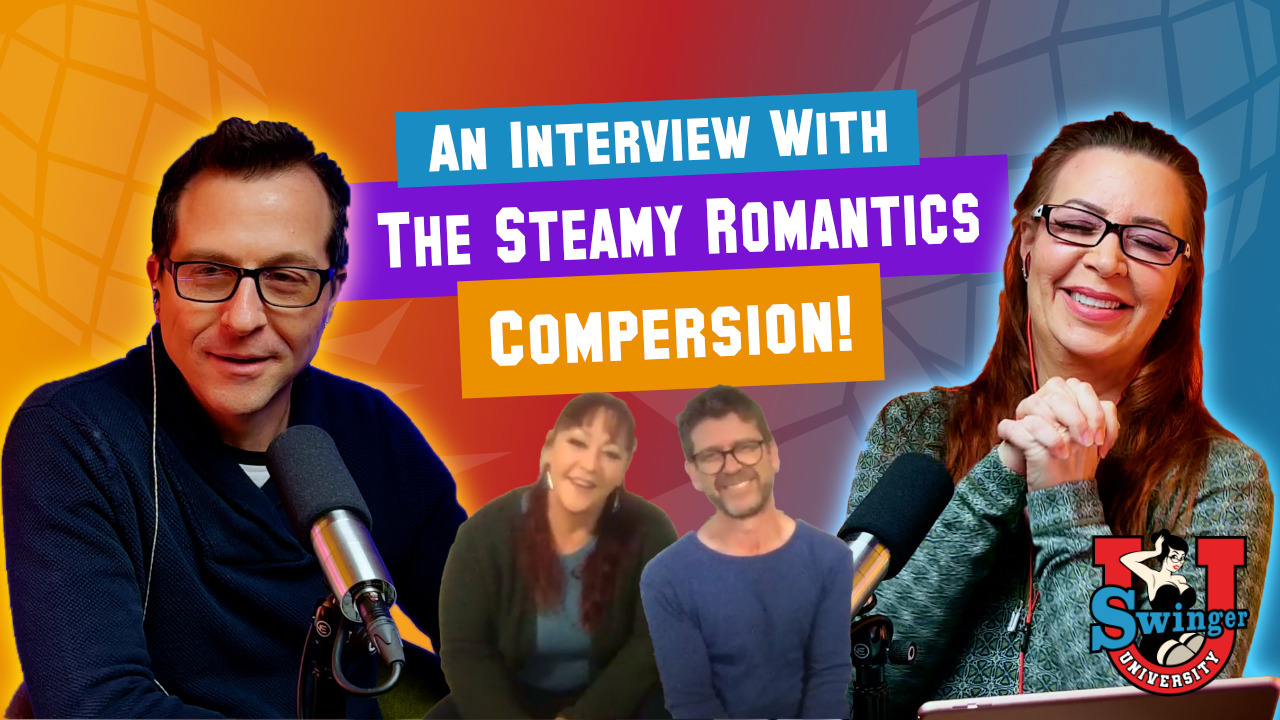
Compersion is learning to grow through other feelings, in order to get to that one. Join us as we speak with the actors and play writes from “Compersion”. Nik and Mik use their autobiographical stories to create an intimate and steamy theatrical experience.
“Compersion” is an adult-only play that celebrates a healthy lifestyle in ethical nonmonogamy, where the characters explore real-life scenarios and participate in erotic intimacy scenes. The audience is also given an opportunity to participate in the play, making it a truly interactive and immersive experience.
Prior to the play, the guests get to enjoy a meet and greet with the cast and crew, where they can learn more about the play and ask any questions they may have. For those who are curious about swinging, “Compersion” provides a real-life look into what one might expect in a swinger event or encounter.
Join us as we speak with the talented writers and actors behind “Compersion” and explore the themes of ethical nonmonogamy and compersion in a refreshing and thought-provoking way.

GUEST BIO:
Mrs SR (Nicole – Nikki) began her performing career with a dance-in-education company touring Australia before further training at Broadway Dance Studios, New York. On her return she ran the company for another 10 years whilst appearing in theatre, film and television. Currently she works as a youth theatre director, specializing in disability arts and ASD. Her passion is social advocacy work on cultural diversity and recidivism projects with theatre companies and local government organizations.
Mr SR (Michael – Mik) is a Doctor of cultural anthropology, an actor, award-winning director, published playwright, and has toured internationally in UK, USA and Australia. In 2016 he broadcast the first ‘livestream performance’ from an Adelaide Fringe. This project was based on his MPhil about an autistic theatre company for which he has presented findings at the Royal Anthropological Institute (UK). He is a freelance Creative Director for governments, commercial enterprises, and arts festivals, creating large-scale immersive art events.
SHOW NOTES:
- About The Play
- The Concept – How it Began
- 20 year Marriage – Getting Started – Experiences
- Deciding on Content
- Real Sex? – Yes!
- Audience Participation/Engagement
- Reciting Lines from the Play
- Tour Dates
- How to Support Steamy Romantics – Patreon
LINKS:
IG: @steamyromantics https://www.instagram.com/steamyromantics/
Transcript
[00:00] [Guest] Hi, this is Ed, and this is Phoebe.
Today, we’re talking to two of our favorite people,
Nikki and Mick from Australia.
They are playwrights and actors from Compersion,
an intimate adult-only play,
celebrating a healthy lifestyle in ethical non-monogamy,
and the meaning of Compersion.
The authors use their autobiographical story
to create this cultural event
by revealing real-life scenarios
and steamy, erotic, intimacy scenes.
First, we have a couple of shout-outs.
We have some new Patreon members that are supporting us,
and we absolutely love your support.
[00:48] [Unknown] Betty and Larry and Asaki.
[00:52] [Guest] So thank you, thank you very, very much.
All right, that’s going to introduce…
Oh, actually, I’m going to introduce Nikki.
So Mrs. SR or Nikki began her performing career
with a dance in education company,
touring Australia before further training
at Broadway Dance Studios in New York.
On her return, she ran the company for another 10 years
while appearing in theater, film, and television.
Currently, she works as a youth theater director,
specializing in disability arts and ASD.
Her passion is social advocacy work
on cultural diversity and recidivism projects
within theater companies and local government organizations.
[01:36] [Unknown] And Mr. SR, Michael or Mick,
[01:39] [Guest] is a doctor of cultural anthropology and actor,
[01:43] [Unknown] award-winning director, published playwright,
[01:46] [Guest] and has toured internationally in the UK,
USA and Australia.
In 2016, he broadcasted the first live stream performance
from Adelaide Fringe.
This project was based on his M…
M-film with an autistic theater company
for which he has presented findings
at the Royal Anthropological Institute in the UK.
He is a freelance creative director for governments,
commercial enterprises, and arts festivals
creating large-scale, immersive art events.
Welcome, welcome, Nikki and Nikki.
Thanks a lot.
[02:22] [Ed] Thank you for having us.
Hello.
[02:26] [Phoebe] It sounds great in your accent.
You can rain to ask Davey any time you want.
[02:34] [Guest] So we really thought your CV was important to read
because for a play of this nature on conversion,
it’s not just someone who decided,
oh, you know, we’ve missed fingers for a few years.
And you know, what the heck?
Let’s try something new.
Let’s just create a play.
You know, I mean, this is not a small undertaking
by any means and you have a wealth of experience and knowledge
behind you and as long time swingers,
which we are going to get into,
there’s a lot of thought
and a lot of hard work that has gone into this.
So as we see all over our industry now,
there’s podcasts popping up everywhere
[03:13] [Unknown] and swing your games and all kinds of crazy stuff.
[03:17] [Guest] But I really think there’s something different here
that you guys have.
I know there is something really different
and I’m really excited to get into it
and discover and share with everybody
what it is you have created.
So explain a little bit about what the play is about
and then walk us through like, what happens?
Like how when you get there and what happens in the theater?
[03:46] [Ed] Well, should I take the first part?
Yeah, go for it.
So the play is, as you mentioned at the top
of an autobiographical or a collection
of autobiographical stories.
So experiences that we went through
as we were emerging into the lifestyle.
And as that process went,
it was a process of discovering events
but also what the impact of those events
have on us as a relationship
and all of that unpacking.
And I guess we found at the time
that even though there was a lot of activity around,
we found it personally very hard to find people
we could share stories with.
And you can’t really go to your everyday friends
that you’ve had for the last 30 years
and sort of unpack some of this stuff.
[04:42] [Guest] Right.
[04:43] [Ed] And so, yeah, it’s a bit awkward.
So…
[04:47] [Phoebe] Well, though, we did try it.
[04:48] [Ed] Yeah, only once.
[04:49] [Unknown] Once, that was probably another anecdote
[04:53] [Ed] we should write about.
But we had several of these sort of anecdotes and stories
and through the process of talking with each other
and unpacking it with each other and all the rest of it,
we would, some of them were traumatic,
some of them were upsetting,
but some of them were quite funny
and some of them were quite ridiculous.
[05:11] [Phoebe] And empowering.
[05:12] [Ed] And empowering and lots of different feelings.
We also found that when we stumbled across the lifestyle
and all the activity that was going on in it,
we also discovered this freedom,
this liberation,
this sort of discovering a new identity.
And all of those sort of feelings combined,
those funny stories,
those dramatic stories,
the feelings that we had about this welcoming new community,
we just wanted to,
it’s just what drives any artist ultimately,
[05:47] [Unknown] you just want to find the medium you use
[05:50] [Ed] to express how you feel and communicate those stories.
So it probably started in a really essential space like that.
And then we began a creative development process.
So we thought, it’s very hard to,
as you can imagine,
it’s very hard to sort of write and create a piece
that is so intimately connected to your own experience.
So we approached it from the position of,
well, we would like to do something like this
to celebrate and share the stories.
Let’s imagine that we were working for a client.
If a client came to us and said,
hey, we want to do this project,
then we would have known all the skills
that we would have to do to put that together.
So we just sort of went right,
let’s park ourselves a little bit
and just now apply the creative process
to creating a work that fulfills what these clients
want to do, which is share these stories
and create a sense of awareness and identity and a platform.
And I guess another cultural contribution
to the community that’s out there.
Really? That’s, yeah.
[06:54] [Phoebe] I think another element is that after working
in theater in particular for this many years
and educating in theater,
one of the things you realize very quickly
is that it is a wonderful tool
[07:08] [Unknown] to experience real feelings
[07:12] [Phoebe] in a safe environment
and to act out real life situations
and see what happens if you’re brave enough
to answer like this or see what happens
if you say no this time.
And to experiment with that,
with real life situations.
And so we were partially aware that
there’s no way to practice.
You can look and you can read
or you can go and throw yourself in the middle of it
and practice it.
But that really kind of,
I just don’t like what you were saying before.
I don’t know what it looks like.
I don’t know what it’s going to sound like.
I don’t know what it’s going to feel like.
And there’s no way to practice.
And sometimes what you’re looking at
[08:00] [Unknown] is actually overstimulating.
[08:02] [Phoebe] You know, in all sorts of ways
that aren’t even important to what you want to go and do.
And so, yeah, I think in that sense,
we recognize there was very little area
for that sort of engagement.
And that maybe Theta would be a great tool
to not only have those feels
because you really do feel the feelings
that you’re feeling.
I mean, that’s part of what you do as an actor
to relive or to make those feelings come to life in the moment.
And so, if you’re able to actually create that in a room,
what happens for a group of people
and their sense of self and sense of community
and what could we do?
Maybe we could help.
Maybe we’re just blowing steam.
But, you know, let’s go see and find out.
And so, yeah, it was a combination of just true honest conversation
about all of our adventures.
You know, you pick it apart afterwards.
You wonder why you did something.
And then you recognize a behavior.
And then you start looking at that behavior.
And then you start, you know, and so,
all of that conversation led to
that realization, you know, it really was a joke.
It’d make a great play.
We would just keep joking about it.
And then eventually, eventually,
we kind of went a lot of, let’s write it down.
And that’s when we started recognizing that
that maybe we had something that was
not only useful, but
maybe empowering.
Yeah.
A homage to the community that gave it to us.
I get back.
Yes.
[09:40] [Ed] So, it’s the second part of your question.
[09:43] [Unknown] Obviously, it’s not a Broadway musical.
[09:46] [Ed] There’s no big set pieces and show tunes or anything like that.
This is a production that’s done as a parlor play,
which was really popular in the 18th and 19th.
And you used to talk about social crime strikes.
Yeah, social issues.
Perfect.
So, it was, so we borrowed that format,
which means that when you come to the venue,
you’re greeted at the venue by us.
It really is sort of set up as if you’re coming to,
you’re coming to a kind of meet and greet
and that we’re hosting.
And part of the night is that we’re going to sit down
and the audience is very intimate, 10, 15, 20 people maybe.
So, it’s a very small gathering.
And we just sort of, we start chatting.
We start storytelling.
And part of the storytelling is that we dramatize some of that as well.
It’s not like we do Big Macbeth,
things in Lawrence Olivier kind of quotations.
But we do dramatize the stories we’ve told.
[10:55] [Phoebe] But before we even begin the show,
there is a really, there’s a generally about half an hour
where we just mingle.
And because it’s such a small amount of people.
And you know, you pour a couple of drinks
and you just ask who’s who and what,
what we were really surprised by how comfortable everyone was.
I mean, we’ve been to parties where everyone just stands there.
Or you might get a couple of little groups
and then there’s lots of people standing around.
And no one’s taking any action.
Everyone’s kind of just frozen.
And so we were very concerned that with a small amount of people
that would be what happens.
That it was too small and intimate.
But actually what happened was that it was comfortable
enough for them to all meet and greet.
Actually, meet and greet each other.
And where are you from?
And how did you get here and exchange those stories?
So by the time the show starts,
that’s given us a chance to get to know them too.
So we actually have a really comfortable,
okay, gang, we’re all here.
They’re our own comfortable.
We all got to drink.
Because we’ve got a story.
And then, you know, and it is intimate as that
and the play begins.
[12:06] [Ed] We’ve worked through roughly,
you know, roughly kind of chronological order of events
that happened to us.
Again, we can’t
many different reasons.
You can’t put exactly what happened in your life on stage.
Right.
You have to sort of make some creative choices there.
And so that’s where the sort of dramatizing
and the narrative part of it comes in.
So it is a story.
It goes for about an hour.
And in throughout the piece too,
we also, there are intimate acts like you said before.
They’re quite intimate,
[12:40] [Phoebe] sex acts, I guess, or solo acts together.
[12:45] [Ed] They are unique.
Because they are part of the story, though.
They’re not.
This isn’t just sort of going to watch a strip show
or watching something like that.
The events that we recreate fit within the narrative of the story.
[12:59] [Phoebe] The question really was,
if that is what happened,
then do we show the truth?
Or do we allude to the fact that I masturbated online
every day for my cert?
Because he was important to me at that time.
And I was, you know, a mess for it.
A hot wet mess for the whole thing, you know.
And that’s the honest truth of the situation.
Do I just say that and let your imagination?
Or do I show you the whole messy truth of what it was like
because part of it was fucking great.
Sorry, my last word.
Part of it was amazing.
Part of it was an act of self-harm
because I was looking for approval.
I hadn’t met myself yet to my own personal needs.
And I was looking for it somewhere else.
So if I’m going to be really honest about that,
this is what it looks like.
Yep, this is how it felt.
And you know, I was really scared.
The reaction I didn’t quite know how to manage that
or how it would be received,
but oh my god, my heart exploded when I turned around.
And face the audience again,
after having done the act was actually
empathy, recognition of acts that they themselves have done.
And in that was this, like it broke the spell of shame
[14:24] [Unknown] that we all had over those acts
[14:27] [Phoebe] because it made us realize we’re all, we’ve all done it.
And we’re all, that’s because we all suffer being human beings.
[14:33] [Ed] Sure, right.
[14:34] [Phoebe] You know, yeah.
[14:35] [Ed] So there are other aspects as well.
We do a little bit of audience interaction
by virtue of the fact that we talk about stories with other people,
but there’s only the two of us.
So it’s part of our performance technique
that we’ve developed through other projects over the years
where we have a process partly involved in that mingling
in the early stages where we might find people in the audience
that are going to be really receptive to being like a plant
or playing a rock coming up on stage and playing a role.
They don’t have to do anything.
They don’t have to be involved.
It’s all consensual.
And we work through all of that sort of in the moment.
But it does mean that people get to come up and get a lap dance,
for example, or come up and pretend to be someone else for a moment.
And then they sit back down or then we might move into the audience.
You might get a massage, you know?
Yeah, that’s what you might get for a massage.
You’d be lucky.
You know, sort of stuff.
[15:29] [Phoebe] But we do spend a lot of time in and out of the audience as well
because it is a discussion.
There are questions where really genuinely asking the audience
[15:41] [Unknown] of ourselves, of you, of the social constructs we live in.
[15:47] [Phoebe] And it wasn’t something we wanted to do.
We’re standing on the stage and you must listen to this idea of ours, you know?
And we recognize you’re here because you are also curious.
And you’re also untying and untangling all these knots and puzzles and riddles,
which means that we can just have an honest conversation tonight.
And we can unveil and unstrip those formalities and talk earnestly.
[16:13] [Guest] Is it a series of little scenes put together?
And then you interact with the audience like with a Q&A in between
or is the interaction done after?
[16:26] [Ed] It’s more, it’s little vignettes and scenes.
Some of them are contemporary and in the stories that we had and experiences that we had.
Some of them are actually reflective.
So my character, me, my character,
goes through unpacked a few little vignettes that happened in my history as a child,
which I didn’t realize until I was in the lifestyle and I’ve done some of that unpacking
that some of those moments had actually shaped me.
So it’s not a sort of, it’s not there to sort of beat myself up.
It’s sort of there to go, well, hang on a minute, that came from somewhere and now I recognize
where that came from. And so I can move forward.
And that was something else that we noticed resonated with members of the audience as well.
The Q&A, the Q&A, it’s funny.
Sometimes we get an audience where at the end of the show,
it does develop into a real Q&A session.
And other times it just becomes a real,
like everyone goes to the table and has a drink to talk,
so I tell her, and just swap numbers and stuff.
So we kind of try and, I think that’s what we’re trying to do really,
is just create an environment that lubricates more of that social atmosphere,
or that ability to talk, whether that’s to express in that kind of Q&A way,
or just to feel comfortable around other people without pressure.
And just create that moment,
and then facilitate it and guide it at the end,
whichever way that goes.
Right, right.
[18:07] [Guest] When I love so much about your play,
and I just need to see it, I’m going to have to take a trip.
Josh Trill, yeah, I just know it.
We’re going to have to come over there, one by the other.
That seeking of knowledge,
that Ed and I did 10 years ago,
when we first got in this wing,
we experienced the same thing that you guys did,
where there just wasn’t anyone to talk to,
and we did, and we searched, and we searched,
and we searched for answers.
We scoured the internet, they weren’t there,
and we listened to the podcast,
and they were all the revisionist history of stuff.
[18:41] [Unknown] And of course, everything was rainbows and unicorns,
[18:44] [Guest] and nothing really talked about the pitfalls of what happens.
Like, not every night is exciting.
Not every experience is great.
Not every conversation is lovely.
[18:56] [Ed] And it’s hard to, I think,
we’ve noticed too, that there’s a lot of people
in that space, podcasts, and therapy, and counsellors,
and there is actually a lot of information out there.
Right.
[19:11] [Unknown] But I think that, yeah, definitely,
[19:14] [Ed] in the last one.
Oh, even in the last four months, just,
and the academic research,
there’s a lot more academic research in the space now,
and that’s, yeah, I don’t know about a lot of that.
Not comparatively.
But we realized that,
well, I guess we wanted to be a part of that culture
of information and advocacy and awareness,
and I guess this is what we can contribute
in that space as theatre makers and performers.
This is how we can do that.
But I think also that,
that theatre, like Nicky was saying earlier,
it’s kind of the original virtual reality.
You can kind of, you can kind of live it,
it’s vicariously through us doing it for you.
[19:57] [Phoebe] You smell the perfume I’m wearing
as I’m sitting right next to you with my hand on your leg,
[20:02] [Unknown] which I asked if I could do while I tell you the next story.
[20:06] [Phoebe] Yeah.
You know, and that’s, it’s a different thing again, you know.
Yeah.
But I think on what you were saying before about,
not everything is beautiful in the lifestyle,
and that, see, that is definitely one of the traps
that I fell into.
I just thought it was so fantasy and so glamorous
and so exciting and all of those things.
And I guess where that led me was exploring
a whole heap of fantasies and woohoo’s
and away from the, from the, from comparison.
Yeah, and I kind of realized it around that point there.
You know, there’s, there may be there,
there is that element.
There’s a lot of people out there who,
who just loved that part of it,
and that’s their stick, that’s their thing,
and that’s okay.
But for a lot of us, that, that lifestyle is, you know,
especially if you have family and work,
and all sorts of other things, that, that glamour
and that fantasy is, is not really the thing that’s magical about it.
It’s, yeah, it’s not the thing that’s magical.
[21:24] [Unknown] The thing that’s magical is the comparison.
[21:27] [Phoebe] And the relationship.
And the real, yeah.
[21:29] [Guest] Yes.
The relationships, the experiences,
those intimate moments where you have aha moments
and experiences that you would have never had
between the two of you.
[21:45] [Phoebe] And yes, yes, yeah.
That bring profound happiness.
Yes.
[21:50] [Unknown] I think there’s something great to your point
[21:53] [Guest] about having a play where you can see real people
acting it out, as much as I love our content
and our kind of genre of content,
[22:02] [Unknown] podcast or, in a sense, academic.
[22:05] [Guest] You can hear about it, you can read about it.
But until you actually see it happening
in that first person, watching people have that,
that conversation, watching couples engage with other couples,
right, that kind of confusion thing,
wait, didn’t they come in with different people now,
and sorting out that whole interchange,
and I think what’s really nice
is that this play gives you a happy medium
between jumping into the pool
and being able to watch people swim around
and kind of get a sense of what it’s like
and not watch a movie of it
where you don’t get that sensory interaction,
[22:45] [Unknown] right, it’s a nice kind of segue into the experience
[22:49] [Guest] which is really, really cool.
[22:56] [Unknown] All right, we need your help
so that your community, the very one you love
[23:01] [Guest] and have so much fun with can also find our show.
Here’s a really easy way to do that.
If you’re listening on Apple Podcasts or Spotify,
hit that follow button and leave us a rating.
If you’re watching on YouTube,
subscribe and turn on notifications.
We can’t emphasize enough how much this helps the swing our community
and it truly is up to you to make that happen.
It makes a massive difference
in whether new listeners can even find us.
And here’s the thing.
When someone searches Swinger Podcast,
the algorithm doesn’t care how good our content is
or how long we’ve been around.
It only cares about ratings and reviews.
We’d appreciate it,
and your community will really appreciate it.
Thanks for listening.
[23:57] [Ed] We noticed too that some of the,
in some of the polyamory and swinging
is sort of cropping up in more and more mainstream media
and TV shows and things like that.
And even in that space,
it’s good.
It’s good drama and they’re good writers
and they’re good at what they do.
But let’s face it,
it is what you’re watching is a highly processed content.
It’s gone through a lot of layers of
of censorship or creative decision-making
and so they cast people that look beautiful
that don’t look like me.
Right.
They look like you know,
so they can actually be alienating
and see we think we hope anyway.
Well, you know,
we’re certainly not supermodels
and we’re certainly not glamorous.
Yeah.
It’s what you see is what you get.
[24:50] [Unknown] And we think about that discussion.
[24:52] [Phoebe] If we do this show,
we’re not supermodels.
We’re not, you know, we are not young.
We are not.
But we also recognise that it is actually people
our age that make up the great majority
of the NM lifestyle at this point in time.
We also recognise that I would really dislike
a 23-year-old pretending to like playing a role
of how they got into, do you know what I mean?
Yes.
Actually, I want to watch you tell me this
because you’re 23 and, you know,
I would struggle with that as an audience member, you know.
But if, but I, so we kind of,
yeah, I did go through that whole thing.
I don’t even know if I want to get up on stage
and strip at all.
Right.
To be honest,
because it’s different than being at a party
or an event or a session.
But yeah, in the end, you know what,
this is also the truth of the lifestyle.
We are real people.
We’re not the black and white pictures
with the beautiful models.
And all that, you know, we are beautiful
and we are incredible.
But we’re, you know, and we’re not 20s rain anymore
and we’re not any of these things
and we’re incredible and happy still, you know.
Right.
Exactly.
[26:06] [Guest] Yeah.
So you, you, you’ve been married, what, 20 years now?
Yeah.
[26:12] [Ed] 20 years this year.
Yeah.
And then how long have you been here?
35, I think, 30, something like that.
[26:20] [Unknown] We met when we were 14 and 13.
[26:24] [Ed] Wow.
And I, I, I still admit that I fell in love at first sight.
But, you know, I took a few years to,
to convince the other way around.
[26:40] [Phoebe] I was a very free spirit.
[26:45] [Guest] That’s amazing.
And then so then when,
how did the first conversation start?
How did you even discover, you know,
swinging or opening up your relationship to somebody?
[26:57] [Unknown] Well, yeah, we get asked that question.
[27:00] [Phoebe] We get asked the question, who asked the question first?
Quite a lot.
And, and, you know, it, I fully recognize
why that question is asked.
But it didn’t happen that way for us.
So it, it’s kind of, um,
[27:13] [Ed] we were probably always non-monogamous that we just,
[27:17] [Phoebe] I think we just kept blaming it on the booze or the atmosphere
or the what they were wearing.
Or, you know, and then we just put it away for a while
and forget we did that.
Until the next time we were,
mm-hmm.
And so, so there really,
[27:31] [Guest] there’s another way we were doing
that gets together with friends for vanilla barbecue.
They end up in the hot tub and everyone swaps and then they go,
well, that was fun.
Let’s never do that again.
And then it’s a, it’s a hot tub effect.
It only happens.
It’s localized just to a hot tub.
[27:47] [Phoebe] That is true.
Yeah.
But yeah, it was always incidental and we kind of went,
what is that?
Oh, I don’t know.
Oh, it was kind of fun to let, we’ll let it go, you know?
And, um,
and then we kind of incidentally happened upon
in a lifestyle somewhere online.
[28:03] [Ed] We just started, well, we just, we just sort of,
I think when, what the heck is this and what’s going on?
And what are we,
maybe we need to look for an outlet.
And so we just started looking around our local town
and we found this club and we thought,
hey, that sounds like a good experience.
Let’s go.
What the heck’s all this going on?
Oh, wow.
I didn’t know this existed.
And so, yeah, we didn’t really have that kind of.
[28:27] [Phoebe] But the more we learned about it,
and the more we went,
[28:30] [Ed] oh,
maybe we should have been doing this a long time ago.
Hit it.
[28:37] [Phoebe] But by then, we’d had 20, you know,
you would have had, I don’t know, 15 years or so,
of a patent behavior, isn’t it?
And I, you know,
[28:46] [Ed] what we thought was the right way to be married.
[28:48] [Phoebe] Married sort of thing.
So yeah, then it was the unpeaking of all that,
happily and willingly.
But what a journey.
[28:55] [Unknown] Yeah, wow.
[28:57] [Guest] I love that.
I just love everybody’s journey and how it’s so, so different.
Fascinating to me.
Yeah.
We have heard of other couples that have kind of just
stumbled into the, the whole thing and realized
that there was a name for it.
Yes.
Yeah.
Oh, this is just what we do.
[29:17] [Ed] Yeah.
Yeah, yeah.
And it was, it was like, oh, we found out people.
Oh, right.
[29:22] [Phoebe] I mean, we knew what, when you were swinging was.
But for us,
when we discovered, you know,
this week, we kind of associated just with swinging,
as we knew it,
which was keys in the jar.
And, you know, more closely to probably to dogging
than actual swinging, you know,
that was our image of it.
And so, yeah, the initial reaction was that it was just a bad shame job.
If anyone knows you are this,
you’re out socially, you’re an outcast, you know.
And this was not acceptable behavior.
And if you hear about people that are doing it,
then it’s a, did you know, you know,
and so that was, that was the image we had of, of swinging.
And then when we started really opening it up
and discovering more about the end and life,
as a lifestyle, as a choice of the ethical,
oh my gosh, then we realized,
no, this is something else.
This is, yeah.
[30:16] [Guest] So, you know, our audience is predominantly the United States.
And I’m familiar with the term dogging,
but I’m not sure the rest of our audience is.
I’m not. Phoebe is not.
I may spend a little time online looking at porn.
But for the audience, could you explain a little bit
of what that term is and what it means?
[30:40] [Ed] Pretty, it is, I mean, it’s got, like every term,
it’s got variations to it, but essentially it’s more engaging in.
[30:48] [Phoebe] You might go to a park or a car park that has been maybe flagged online somewhere
that people will be coming and going from this area.
There are actual areas that are well known for dogging.
So you just go in the car and you wait and you get the kind of look from someone
and then you just go and have a raunchy hot,
hard, fast time with a complete stranger or a few complete strangers in a very public place,
really. Um, yeah.
So it’s not my idea of a rush, but I can, I get it.
I totally get it.
[31:24] [Ed] But it’s more about that just hard and fast sex with some who’s an anonymous and a stranger
and that kind of, yeah, that kind of environment.
Yeah, it’s exciting to realize they’re new.
[31:38] [Guest] Yeah, it’s in a risky spot.
Right.
Yeah, the equivalent that we have here is the, the whole glory,
whole experience where, you know, you show up to the adult bookstore,
you know, you don’t know who you’re going to meet kind of a thing.
Um, this is, uh, it’s interesting, but it’s all anonymous.
[31:57] [Ed] It’s that anonymous risky kind of behavior kind of thing.
And that that’s fine, like, you know, totally get that,
but just not.
[32:05] [Phoebe] Unfortunately, though, there you could go spend your whole day sitting in that car park,
be sick and guessing everything that happens, you know, and nothing happens.
[32:14] [Unknown] So, was that the signal?
[32:16] [Guest] I don’t know.
[32:16] [Phoebe] I don’t know.
I’m not going to go check.
[32:19] [Ed] No, it’s just flicking these lights out there.
All right.
[32:22] [Guest] Right.
So you’re the, the experiences that you’re drawing from in the play,
[32:29] [Unknown] these are the experiences that are after you discovered
[32:36] [Guest] ENM and swinging was a, was a real thing, or do some of them,
these experiences go back to when you were just
doing you and you didn’t even know what swinging was.
[32:47] [Ed] Yeah, they, they start, they pretty much start from where, from that moment,
where we, when, oh, this is what, what we’re into.
Okay, let’s actively go and look and see what, let’s go on practice.
And so how do you do that?
How do you meet people?
How do you, like, we had experiences with people where,
especially when we were, we were new.
We had experiences of people who had claimed to be in the lifestyle for a long time.
And so we went into that experience, and we had a few dates and meet and greets,
and that all went well.
And then we, we had the night where we all hooked up.
And, and because we thought they were seasoned swingers,
we thought they had, and we were new.
[33:30] [Phoebe] And there’s so much, who about being a newbie?
[33:33] [Ed] Yeah, we thought that they must have the same level of knowledge about
consent and communication.
They will guide us.
They would, they would be okay with that we would be, but what turned out is that,
that didn’t happen at all.
[33:47] [Phoebe] We never had a conversation.
There was no consent.
[33:50] [Ed] And it would just tend to go very messy very quickly.
That was one of those, that was one of those experiences.
But, you know, earlier in the week, or that,
I can’t remember earlier in the week, we’d had another brand new experience that was,
that we really, really will.
[34:05] [Phoebe] Like something out of a movie, you know.
No, no, no, no.
They tell brand, photographer, our enlightening set.
Oh my god, it was amazing fun.
[34:13] [Ed] So we’re going from, oh, hi, yeah, we’ve got this.
We know what we’re doing.
And let’s go into the next experience.
Oh, shit.
Yeah, we know.
[34:22] [Phoebe] And, you know, and all the bits and pieces you learn along the way about,
consent, and how to achieve it.
And, and you know,
[34:30] [Ed] and there’s practical tips too.
There’s practical tips, like, don’t eat a spicy meal when you go out on a date.
Because that will come back to bite you in the butt later.
You know, there’s handy hints and tips for the,
[34:41] [Guest] yeah, or, yeah, don’t eat asparagus, you know,
yeah, right?
So, yeah, we do the same thing.
Always calculating what meal we’re going to have a few days ahead
before we have a date.
[34:55] [Ed] They’re the sort of things that I think,
I don’t think we ever read or heard about those conversations.
They were, they were learning on your job, you know, kind of raising your shit.
[35:05] [Phoebe] The other thing is, you know, like, after you’ve had kids for a certain many years,
especially if you live in a smaller house,
you know, for us, we didn’t, we didn’t, we, we have to be quiet.
And so basically, and so when we went to the lifestyle,
we realized we’d lost our voices.
Yeah.
Not just, yeah, we didn’t know how to talk at all anymore.
[35:27] [Ed] Didn’t even know how to orgasm on voice anymore.
It was like, everything’s quiet, you know, like,
[35:32] [Phoebe] you know, and these are things we don’t talk about either, yeah.
[35:35] [Ed] We wouldn’t even realize we’d sort of forgotten,
but we hadn’t done it.
It was like, oh, my God, we’ve just lived this life for so long,
we’ve completely forgotten that we used to do this all the time.
Right.
That’s what was that, yeah.
[35:48] [Guest] Yeah, suppressing all of the noises that you make in the bedroom
is also something that we went through where,
you know, they were one floor above us and a couple doors down
and we got very good at being quiet.
And when you can take that muffler off,
like you said, you’ve forgotten that you can make noise
and how to make noise.
It’s, it’s crazy.
So when you, yeah.
[36:15] [Phoebe] So when you don’t have a voice to express your pleasure
or whatever, you also don’t have a voice to express your concerns
or your issues or to be able to say, actually,
no, I’d rather you didn’t do that.
Or, you know, actually, could you do that?
Could you do that?
Right, right.
Exactly.
So, yeah, if that took a lot,
that was harder than I ever expected it to be
and was the cause of a few hard knocks
because I just couldn’t say something, you know,
and then you walk away, you beat yourself up, you go, you know,
you’re a strong, very independent woman.
What was that?
Yeah.
Are you 15 again?
What do you like?
You know,
and you go back in and you go again.
[37:00] [Unknown] Yeah.
[37:02] [Guest] That is a hard-learned skill.
And I think it’s something that we still struggle with too,
even after having been in the lifestyle for 10 years.
Here’s why we sail on Virgin.
It’s adults only.
No kids screaming at breakfast.
No family buffet lines.
Just champagne at noon.
Late-night pool parties and people who actually want to be there.
The vibe?
Think boutique hotel that happens to float.
Tattoo parlors, drag brunch, restaurants you’d actually pay for on land.
Plus, when you’re looking to connect with other couples who know how to have fun,
let’s just say Virgin attracts a very specific type of adventurous.
No wonder bread cruisers here.
Just your people.
Yeah, I really had to learn to ask for what I wanted in order to have a good experience.
And be comfortable doing that, standing in your own body and saying,
yeah, I deserve to feel this and I deserve to have that and I’m going to ask for it.
And if it’s not pleasurable, then I don’t have to lay there for subjective set of time,
just because my partner is having a good time.
I can get up anytime I want to and leave, right?
I mean, or move to the different side of the bed or do something different.
So there’s all kinds of things that you think that my partner is still engaged with
his other individual.
So I must stay here too.
But no, I need to get up, go to the bathroom, get a drink of water, come back,
you know, like do something different.
Yeah.
[39:00] [Unknown] So yeah, all that.
[39:03] [Guest] No one talks about any of that, right?
So how did you take or decide on what content you were going to put in the play?
And do you rotate out scenes?
[39:14] [Ed] Well, we started by, it started probably as a almost a journaling exercise for nature.
We just wanted to write, like we realized when we’d had a shared experience,
but we’d had individual experiences of it.
Gotcha.
And that was probably, you know, that was often part of the, some of the more unfortunate conversations
we had with each other after events is that one person had a perception of what was going on
and the other one saw something completely different.
So we just started with, we just started with journaling.
[39:52] [Phoebe] Made another assumption, maybe?
[39:55] [Ed] Started journaling those stories from each of our own individual perspectives.
And then we sort of swapped them over.
[40:03] [Phoebe] And they were just sort of we let each other kind of edit.
So Michael might write a whole scene about his childhood and how he was introduced to sexual
education by his father or something like that.
You know, and you go, I think it’s all right, but I have a read.
And so we’d swap over.
And then we’d talk back to that, which initially, I’m going to be really honest,
[40:28] [Unknown] was a little bit painful sometimes because I think you’ve been honest with each other
[40:34] [Phoebe] and with yourself to sit down and start writing it out and reflecting and then it all comes out.
And then you go, oh, do you know what?
I think the real truth of this whole shabang that happened here was actually all about this,
you know, and then you’re discussing that.
So yeah, it did crack open some stuff for a while.
Did, and having to relive some of the moments that you maybe didn’t enjoy,
[40:59] [Ed] or to re-stage them on, yeah, to restage a moment that was awful.
Okay, how do we?
[41:07] [Phoebe] And to, yeah, so sometimes we did recognize that we recognized that certain stories
didn’t actually serve any purpose towards what we wanted our audience to come out with.
You know, it was great for us.
Catholic to write it down might make another great play.
We’ll just put it aside.
But this one, this one, and this one, these are powerful because this one demonstrates consent.
This one demonstrates consent backwards from the male, you know,
I’m sorry, abuse, sexual abuse, but from the male, not the female having had it done to them.
This one demonstrates this, and this one demonstrates that, and this one shares this truth.
[41:50] [Unknown] And so I think we collectively picked what all of those elements we wanted to really harness
[41:57] [Phoebe] and cover each story that many, that did that best, and then we dealt the rest.
[42:04] [Ed] And then we then we sort of put a, then we had the change hats,
and sort of act as that sort of scriptwriter that, that different person for the client,
and just actors and dramaturge and a scriptwriter and go, okay, what’s going to make sense
in terms of that?
Right, right.
And then it was, and then it was a different hat again when we went, okay, now we’ve got to put
on the floor, how do you stage that?
How do you, how do you represent that?
How do you, how do you cope with sightlines and costume changes?
And well, it doesn’t make sense if we go from here to here, okay, so let’s put that scene there
and we’ll move that one over there and we, and so it started very, I guess, overall it started
very kind of formless and shapeless as an expression. And then as the process goes along,
we sort of refine it and refine it.
And even now that this new season that we’re doing now where we’re still refining the performance,
we’re still developing moments, we’re still like that moment, like, you know, we might do a run
a performance and we go, oh, we’ve got a reaction from the audience there that we haven’t got
before. So what are they picking up on? What can we, how can we enhance that moment? How can we
make more of it? Right. So it’s, it’s constantly evolving and refining as we go on.
[43:19] [Phoebe] Yeah. And, and we, we will still sit down and rehearsal and say, okay, what is the purpose of
this scene? Why are we, why are we here? Are we just doing it? So we can say, we get talk up
with the massage therapist regularly. Well, it’s cool. We should shout that from the tree tops.
But is that the only purpose of this scene? No, the actual purpose is that is the friendship and
the connection this person gave to us. Yes. And the return to connection that he gave to us.
Oh, right. Well, let’s not focus too hard on that. That’s me, you know, and so it is, it is
[43:52] [Ed] important to keep questioning. And keep, and, and that, it looks like that gets determined also
by the responses of the audience as well. I mean, that’s the, that’s the, also the beauty of theater.
It’s a two way conversation. Every show is different. Every audience comes in. Some audiences are
laugh a lot or and respond a lot. Other audiences are really quiet. They’re the ones that are
[44:14] [Unknown] listening really hard. Yeah. Yeah. So we, we had you guys on, we, I had a request that you guys
would recite a few lines. Are you, are you able to do that? Yeah, sure. Well, I’ve got here
[44:36] [Ed] the one of my opening monologues. I can, yeah, it’s sort of, it’s this monologue sort of,
it’s early in the play. So it’s kind of trying to set up what the play is about and where the
journey is going to take us towards the end. We’re all in everyone. We’re officially
[44:59] [Phoebe] welcome. We’ve explained who we are, what we’re doing here, what the play is about to be about.
We’ve given a very quick demonstration on consent with an audience member, which is a good fun.
We’ve stripped naked and that’s one of the first five minutes. And, and, and this is when
[45:19] [Unknown] Mick does this speech. Hey there, podcast listeners. You’ve been tuning into our episodes,
[45:30] [Guest] but have you ever wondered about the steamy details of our adventures or maybe hungry for some
sultry erotic stories? Well, guess what? We’ve got something special just for you. Our exclusive
Patreon page. It’s like a VIP pass to the saucy side of our world. So if you’re ready for an
exclusive behind the Mike experience, head over to our Patreon page now. Trust us. This is where
[45:57] [Unknown] the magic happens. See you there, patrons. When was the last time you had a brand new feeling
for the very first time? Can you remember? I’m not talking about new experiences that redefine
[46:19] [Ed] existing feelings. I mean a new feeling, an emotional, psychological, physical sensation that
[46:27] [Unknown] is not connected to any previous experience. Maybe you’ve had a feeling that not the word for it,
[46:37] [Ed] Shardin Freud. Great word. It means to take pleasure from someone else’s misfortune. It’s
[46:44] [Unknown] German for suck eggs. But what’s the opposite? Have you ever had that? Do you even know what it is?
[46:54] [Ed] Okay, different example, jealousy or envy. Now, they are different, but for now we’re just going
to bundle them up under a definition of anger or bitterness at another’s joy or pleasure. We all
[47:08] [Unknown] know that one. But can you imagine the opposite? Have you ever desired that? Does it even exist?
[47:22] [Ed] And how can you know a feeling that has no vocabulary, no way to express it? Some of the happiest
moments I’ve ever had in my life have involved watching Mrs. SR have sex with other people,
mostly men. Now believe me, that’s something I thought I would never say, but it’s true.
It’s a feeling that is so full of happiness that my whole body glows and there is a word for it.
Now, you may be sitting there wondering how on God’s green earth did you get there? I can’t possibly
[48:02] [Unknown] imagine that. Maybe it triggers a reflex response in you in your body right now, tight, hot,
[48:13] [Ed] or prickly. There is a gap between that feeling and mine. It’s a fog-filled chasm
[48:22] [Unknown] without a floor, safety net, or a rope bridge. It’s too far to jump. But I wanted to be there. We both
did. It was calling us. So we walked into the fog, into that chasm, into the great unknown.
[48:50] [Ed] We read and we researched, we had new experiences, some successful, some not. We yelled, we hit
[49:02] [Unknown] and we hurt each other because it was scary because it was hard. It was a lonely journey of
self-discovery, of riddles, puzzles, and of knots. But learning anything new takes practice.
Yes, very well written. Oh my gosh. I love the choice of words because they resonated with me and
[49:37] [Guest] a lot of the experiences that we went through and just dead onto that vague sensation that you wander
[49:46] [Ed] through that fog. Without a language or if no one’s ever told you, I was thinking about it and
talking about it on some of the other day. Like jealousy, envy, anger, all of those things. If you
look through literature, if you look through theatre and all the plays we study, all the great
characters, that’s what drives them. Yago is jealous. Yago is envious. They’re all driven. That’s
[50:16] [Unknown] what creates drama. And that’s fantastic. But I can’t think of a character that’s ever been written
[50:25] [Ed] that sort of celebrates the opposite. There’s no drama in that kind of drama.
[50:29] [Phoebe] Generally, a character who celebrates the opposite is an innocent or a fool.
You look at Ted Lasso. He’s probably as close as you can get to a comparison of human being
on television. Character on television. But he’s still portrayed as that kind of… He’s still the
[50:48] [Ed] fool. Yeah. Right. Yeah. Yeah. And I think this is a, yeah, it was that process of man,
there’s got to be another way to think. This way of thinking doesn’t work. But what is it? I don’t
[51:01] [Unknown] know what it is. And I cannot feel it, but I can’t. And then we discovered the word. Even the
[51:08] [Guest] social definition that you run into in the lifestyle all the time about drama. And we don’t deal
[51:14] [Unknown] with couples who have drama. That’s that very definition of strive for conflict or all of those
[51:24] [Guest] things that you talked about that really focus around jealousy or envy or anger or frustration.
But that opposite feeling is really kind of a passive thing. It’s an internal thing,
and you don’t really even see it on the outside other than a really nice smile.
[51:47] [Unknown] And it is something that we can pull apart, jealousy and envy. We can
[51:55] [Ed] compartmentalize where bits of it get triggered or where it happens or what circumstances
it might happen under. But it’s almost like an active process to constantly redefine what
jealousy and envy is. But like you say, that the opposite just seems to live in this benign,
[52:12] [Unknown] passive vague kind of experience. Well, well, what if we actually invested some time into
[52:20] [Ed] to practicing that and applying that? And I think that’s more broadly what we also liked about
the word and the idea is that just outside of the lifestyle, it’s not a bad idea to apply in
[52:32] [Phoebe] your life generally, right? Someone was saying to me the other day that they were looking at it
in this beautiful way, just knocked my brain. They’re not even in the lifestyle. It’s just that
we were talking about comparison because I just apply it, you know, to whatever. And they
said, oh, I get it. You know what? That’s like when when you’re watching a baby, a really young kid
get a birthday cake, you know, or their first cake. And they they just take that thing and they
put it all over their face. And this is the most happiest, most explosive amount of joy in that room.
And you don’t you don’t feel like you’re peed off that you didn’t get any cake. All you’re doing
and you know, or that the cake is ruined. You just completely full of joy watching their happiness.
Like watching their happiness makes you feel so much joy. And any and you look to me and he goes,
yeah, you don’t do that, do you? To get to knock that out gets knocked out of your after that, though.
And I just went, yes, absolutely correct. You’re allowed to you’re allowed to have a cake and eat
it too. And enjoy your life and be happy when you’re little. But when you’re older, you know
that you shouldn’t be doing that with the cake and the right thing to do is share it and the right
thing to do is use it not from fork and the right thing to do is. So I went when you were reading,
[53:56] [Guest] I just wanted to touch on one last thing before we wrap up because I really want to tell our
listeners where they can see you. And if you’re going to be on tour and all that good stuff.
But when you were reading, I instantly I close my eyes for a little bit because I just dropped
down into the space. And I realized I already started feeling, you know, what you were,
that what you were saying. And I already started to deeply process your words. And the reason
that was is because there was silence around me. There wasn’t any, there wasn’t loud music,
there wasn’t, you know, voices. And so this is why I think the play is so impactful because
it’s like you’re in a bubble where you’re just focusing on that and you’re processing all that
information in that moment, not in a chaotic environment, not listening to a podcast while you’re
driving or in the gym, you’re getting bits and pieces of it. You’re not really comprehending
everything that’s there. But in the play, you’ve got the smells, the visual, the
even contextual, if you’re, you know, if you’re a participant in the play, it’s almost
[55:09] [Phoebe] repetitive. Yes. But you’re not alone, which is something you are a lot in the lifestyle.
Now that sounds really odd to say that you’re often alone. Yeah. But it’s nice to be given
that time and space, but to not be alone in it for a change. Right. Yeah. Yeah. Yeah. That’s true.
[55:31] [Guest] Oh gosh. I love what you guys are doing so so much. So, so we’re can everyone,
like, what, let me, yeah, where can they find you? What are some potential tours? How do people
find you? What kind of feedback are you getting? All this good stuff, like, and how do people support
[55:52] [Ed] you? Okay. Well, probably the best place to start is the website, which is just steamyromantics.com.
Okay. You’ll be able to, yeah, from there, you’ll be able to pretty much find everywhere else we are.
We have a, a Patreon page to first support us to help us continue creating. And that was
based, thank you very much for that advice. That was fantastic. Yeah. It’s been working already. It’s
[56:17] [Phoebe] awesome. Patreon is great for us too, because it’s actually a space where we’re not, we can,
we can talk about the creative process and all of the bits and pieces of our lives that we generally
wouldn’t share on Twitter or Instagram or other places. It’s kind of like, we’ve kind of used it
[56:33] [Ed] like our kind of, I don’t know, if you would go to, if you were to go to an artist or a pottery studio,
it would be the place where they sort of put up the new work and put up the new idea.
[56:42] [Phoebe] Yeah. Yeah. Yeah. Well, something I can’t or a brain worm, you know, one of those thoughts that
just keeps going around and I can’t get through. Maybe someone out there’s feeling it too,
or someone had experience and it’s very nice to be able to share those that were somewhere
[56:59] [Ed] into the evening. It’s clear. If you’re a Twitter follower, then this whole thing started when we
created a shared Twitter account and really we created it almost as a, like our own photo journal.
When, when we’re on to crepid and we can’t do this anymore, we want to look back on the things
we did. So we started it like that. It’s a good ride. It’s just kind of groovy from there, really.
But most immediately, we have a season coming up and Adelaide South Australia in April,
middle of April, 1718 and 19, the details on the website. And by the end of this year,
we’re working towards being in Sydney, Melbourne and hopefully Gold Coast as well.
And in the meantime, we are advocating and working at Butts Off to try and
organise some tours to Europe and USA as well. And like I could say, it’s a parlor show. It’s
really does, it really does fit into a suitcase. It’s just us, our costumes and a boom-boom.
[58:00] [Phoebe] There’s no lot of costumes, really. Not a lot of costumes either.
[58:02] [Ed] So it’s these scanty. Harry on luggage kind of stuff. So we’re looking to, yeah,
broaden it out and start touring and start. I think creatively, we’re really excited to start
taking this overseas because we, for a couple of reasons, one, we want to see how this work
responds inter-culturally, like how, like this is a, you know, particularly an Australian experience,
particularly Australian Adelaide experience. But how does that resonate with people from different
cultural backgrounds? That’s the anthropologist and me, obviously. But also because of the way we
work, we, it’s by mingling and having exchanges and conversations with people that informs the
next piece. That’s where the next story and all the work that we want to create in this space,
we want it to be reflective of genuine experiences. And if people aren’t sharing these,
[59:03] [Phoebe] these experiences with each other, God, they must be dying to just get some of this stuff out
or to say, you know, like, hey, I have this story, right? You know, I don’t want to be named.
But it’s, you know, or I have this issue or this real thing that I’m starting, I really want to
talk about it. I want to talk about this so that I think that gives us this beautiful ability to
represent more voices. And the more voices that we can get out, the more we realize we’re all okay.
[59:36] [Ed] And in that sense, too, that’s what we hope the Patreon page is for as well, because we
recognize there’s other aspects to the community that there’s, we’re both advocates of diversity,
neurological diversity, ethnic diversity, all sorts as well. And we, we are obviously
to middle-aged white people and we, we don’t really feel like we can represent that, but we would
like to try and find a way of incorporating a voice for those people as well. Right.
[01:00:03] [Guest] Right. I want to wrap up today’s show by a quote that you had. I’m not sure if you said it in
your opening monologue, but I just love it. You, you had expressed it earlier when we had a meeting.
And you said, compersion is learning to grow through the other feelings to get to that one.
And I feel like that is so true of our journey. And it, that is expressed perfectly
of what we have experienced and what I see has been our process as well. So I, I think that’s
really important to, to, for everyone to, to honor all those other feelings. It’s important
journey. You’re not going to just get there magically. It is a journey. And it’s not a journey
[01:00:52] [Ed] for the light-hearted. It’s not. No, no, it’s relationship on, on the hard-level extreme
[01:00:59] [Unknown] club mode. It is. Good line. Well, thank you so much. We are so glad to have you on our,
[01:01:08] [Guest] on our podcast. And we, we will definitely follow you and promote you and, and, and, and follow
you wherever you are going and opening. So please, we keep in touch. We will, we already follow you
[01:01:21] [Ed] on social media. So I’m sure we’ll, we’ll, what you’re doing. Look forward to being able to
sit in the studio with you. Absolutely. And that would be fine. Maybe we’ll, we’re starting the
[01:01:33] [Phoebe] next launch from the next one as well. That would be amazing. That would be. Thank you so much. Yeah.
[01:01:41] [Unknown] Thank you, but absolutely delightful. Oh, one last thing before you go. If this episode helped
[01:02:11] [Guest] you in any way, the single best thing you can do to support the show is leaving a rating and review.
It takes 60 seconds and helps new people find us when they’re searching for relationship
education. And we’ve made it easy. Visit SwingerUniversity.com forward slash review. All the
instructions are there. Thank you for being part of this community. We’ll see you again soon.